
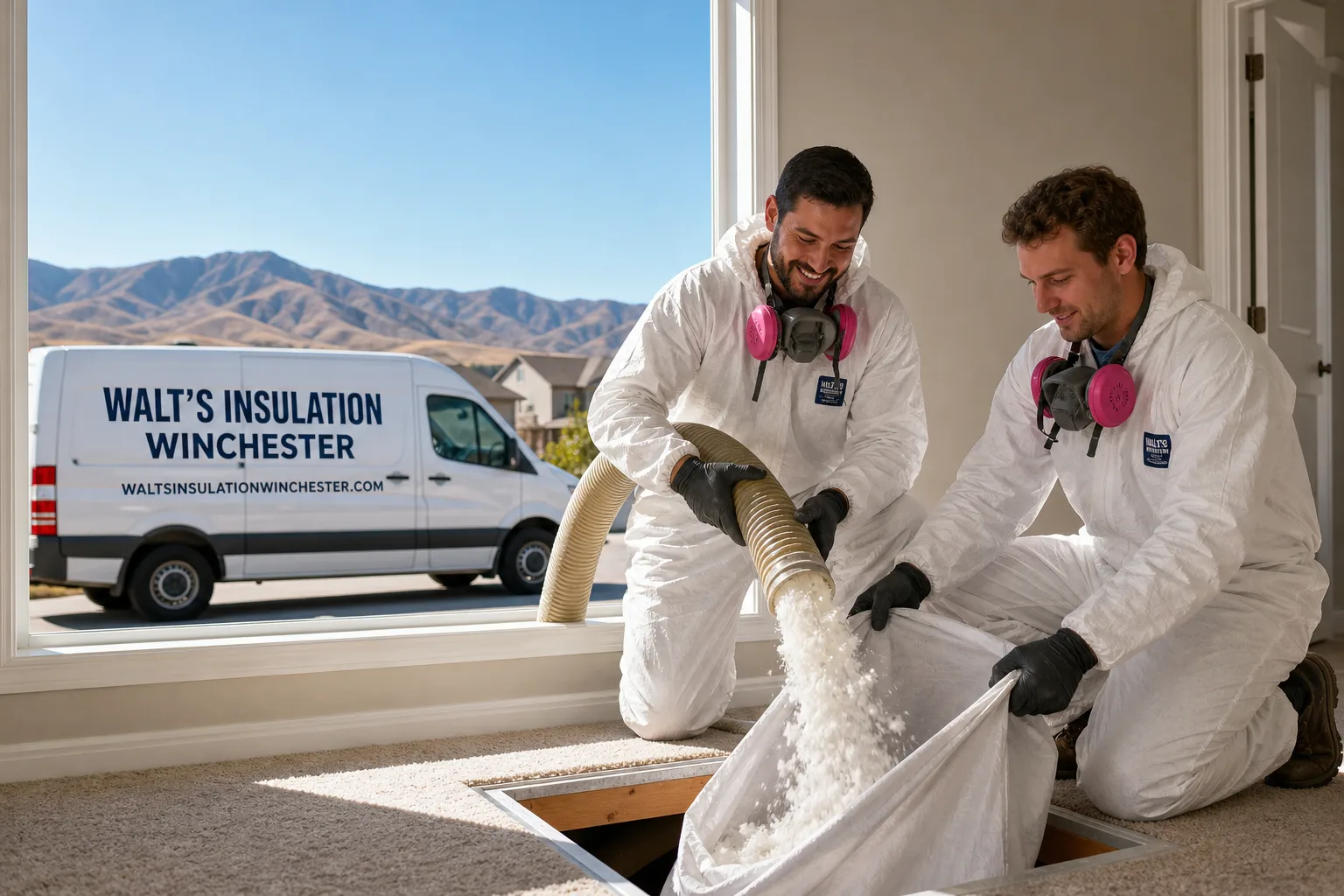
Fast, Reliable Radiant Barrier Installation Across Sandy Valley
Sandy Valley homes take a beating from the sun. Summer afternoons push well past 100°F, and winter nights here drop into the 20s and 30s, a swing of more than 40 degrees that most attic insulation was never built to handle. We install radiant barrier systems in Sandy Valley that reflect that solar load before it ever reaches your ceiling, and we know the ranch properties and manufactured homes out along the valley because we work in them. Call (844) 907-1847 and a live person picks up, day or night, to set up a free estimate.
Why Walt’s Insulation Winchester Is Sandy Valley’s Preferred Radiant Barrier Installation Company
Sandy Valley is rural, spread out, and full of homes that were built without much thought given to attic performance. We’ve built our reputation here on showing up when we say we will and pricing the work in writing before anyone touches your roof. Homeowners who’ve been burned by no-show crews and vague quotes tend to stick with us once they see how a background-checked, uniformed technician actually handles a job. Our technicians bring up to 26 years of experience to every Sandy Valley install.
Response to Sandy Valley is quick because we treat it as a core part of the area we cover, not an afterthought on the way to somewhere else. When you call, you reach a live person 24/7, not voicemail. And every install is covered by the Done Right Promise: if it’s not done right, we make it right, no runaround.
Our Radiant Barrier Installation Services in Sandy Valley
There’s a right way to build a radiant barrier for this climate, and a lot of ways that quietly fail within a season. Here’s how we approach the work in Sandy Valley.
Attic Radiant Barrier
Most Sandy Valley attics we open up have a thin layer of old batt insulation and no barrier at all. We air-seal the attic floor first, then staple perforated foil to the rafters with a proper ¾-inch air gap so the foil actually reflects instead of conducting. In a typical Sandy Valley ranch home, a homeowner who notices upstairs rooms running 8 – 10°F warmer than the rest of the house usually has an attic hitting 140°F+ under Mojave sun, and this is the fix.
Radiant Barrier Roof Deck
For custom homes with more elaborate roof assemblies, a roof-deck barrier keeps the heat from ever soaking into the decking. This matters in Sandy Valley because the same foil that blocks summer heat gain also helps hold warmth under the deck on cold winter nights, cutting the load on your heat pump from both directions.
Radiant Barrier & Ventilation
A barrier is only as good as the airflow behind it. We install baffles and balance soffit-to-ridge ventilation so the attic can breathe, which in Sandy Valley’s dusty environment keeps the foil surface clean and working. Skip this, and the barrier loses reflectivity within a season.
Radiant Barrier Foil
Perforated foil is our standard choice for Sandy Valley attics, and the perforation isn’t optional. Non-perforated foil in an under-ventilated attic traps moisture that condenses on cold nights and rusts fasteners or rots decking. We match the product to the attic, not the other way around.
If you want the full picture of what our Radiant Barrier Installation work covers, it’s all laid out there.
Trusted Brands We Service in Sandy Valley
We install radiant barrier and insulation products from manufacturers we trust to hold up under this kind of solar load, including Owens Corning, Johns Manville, and GreenFiber. We don’t claim to keep parts or materials stocked on a truck, and we won’t pretend a warehouse sits around the corner. What we do is line up the right product for your attic and get it installed without a long wait.
Common Radiant Barrier Installation Problems We See in Sandy Valley Homes
- Foil pressed flat against the roof deck. With no air gap, the barrier turns into a conductor and does nothing useful under Sandy Valley’s extreme solar load. We always build in the gap.
- No air sealing before the barrier goes up. In older manufactured homes, desert dust migrates into the attic and coats the foil, dropping its reflectivity within a single season. Sealing first keeps the barrier clean and working.
- Non-perforated foil in a poorly vented attic. Moisture condenses on cold winter nights, rusts fasteners, and rots decking. This is a common and avoidable failure in Sandy Valley’s temperature swings.
- Thin or missing floor insulation in manufactured sections. We often find little to no insulation in the floors of older units, which means cold floors even in a mild winter, and a barrier alone won’t fix that.
Pricing for Radiant Barrier Installation in Sandy Valley, NV
A typical attic radiant barrier in Sandy Valley runs $1.30 to $2.10 per square foot installed, which puts most single-family attics in the $1,800 to $3,600 range. Roof-deck barrier for a custom home tends to land between $2,200 and $4,200 depending on roof complexity. Adding air sealing and ventilation baffles usually adds $400 to $900, and that step is worth it here. What moves the number most is attic size, whether air sealing is needed first, and how accessible the roof structure is. Every estimate is free, and there’s no trip charge inside the county. For seniors and veterans, we keep a permanent 10% discount. Call (844) 907-1847 for an exact quote.
We Also Serve Cities Near Sandy Valley
Sandy Valley sits close to a lot of neighbors we also serve, including Winchester, Paradise, Sunrise Manor, and Whitney. If you’re just outside Sandy Valley and wondering whether we cover your street, call and ask. You can read more about Radiant Barrier Installation in Sandy Valley and the surrounding area on our city page.
Serving Sandy Valley, NV – Our Local Coverage Area
We serve Sandy Valley and nearby communities. Use the map below to see the area we cover. If you’re nearby, we can almost certainly help.
FAQs – Radiant Barrier Installation in Sandy Valley
Yes, and that dual benefit is the main reason it’s worth doing here. Because Sandy Valley homes are off the natural gas grid and run all-electric heat pumps, the same foil that blocks attic heat gain in summer also helps hold warmth under the roof deck during 20°F winter nights. Call (844) 907-1847 and we’ll walk through what your specific home would gain.
In most cases, yes. We air-seal around the existing insulation first, then install the barrier over the rafters, so you don’t need to tear out what’s there. A free second opinion on any written estimate is always available if another contractor has told you otherwise.
It does. You need perforated foil and balanced soffit-to-ridge airflow so the attic stays clean and dry. Skipping ventilation in this dusty environment lets the foil surface degrade fast. Call us for a free estimate on getting the detailing right.
Roof-deck barrier sits against the underside of the decking and stops heat from soaking in; attic floor barrier works at the ceiling plane over your insulation. For custom Sandy Valley homes with complex roofs, roof-deck is often the better fit. We’ll tell you which one your house actually calls for, free of charge.
It can, but only when paired with air sealing. The barrier itself isn’t a dust barrier, yet sealing the attic floor before install is what keeps desert dust off the foil and out of your living space. The wind-driven dust out here makes that sealing step essential rather than optional.
Radiant barrier work pays you back on both sides of the year in Sandy Valley, and we’d rather tell you the truth about what your attic needs than sell you something it doesn’t. Call (844) 907-1847 for a free estimate, and a live person will pick up 24/7. We also offer $40 off any repair over $200. The one down the road.
Written by the team at Walt’s Insulation Winchester.