
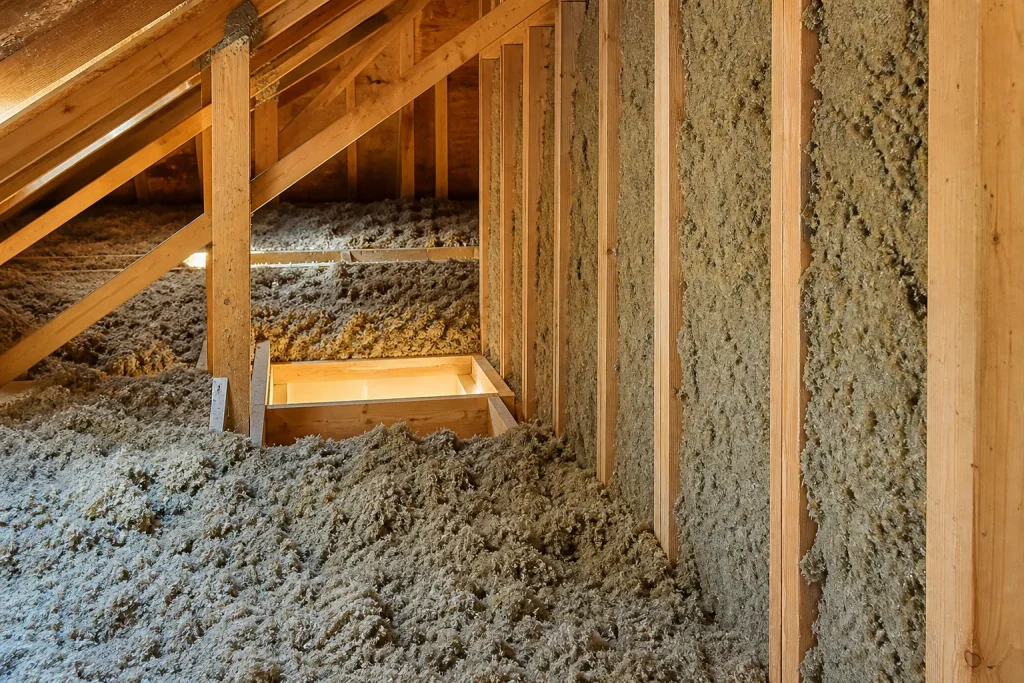
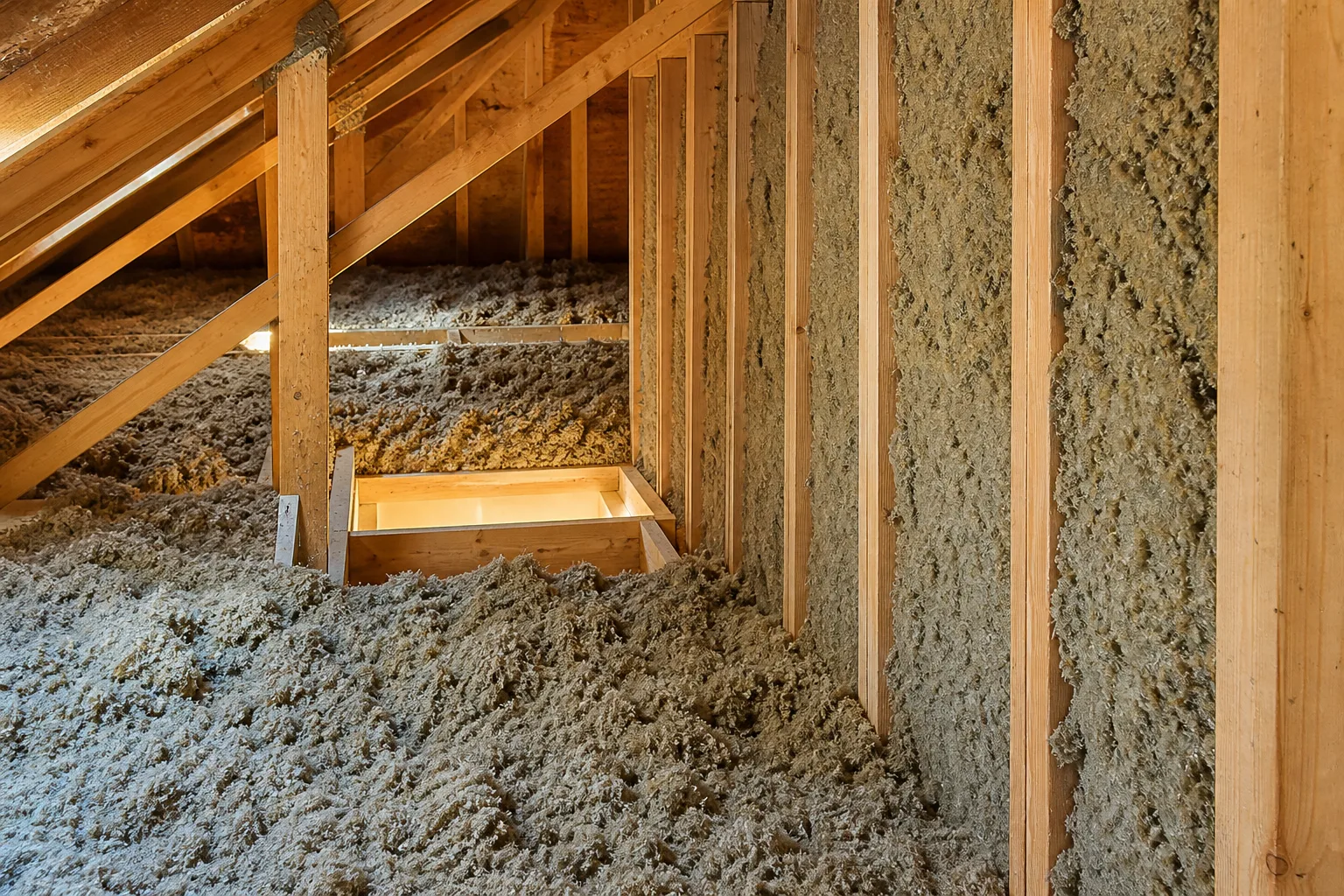
GreenFiber Attic Insulation in Winchester: A Homeowner’s Guide
GreenFiber is made from roughly 85% recycled paper, which sounds fragile until you learn it handles Nevada’s dry heat better than many fiberglass batts at the same R-value. Most reviews of the product come from humid, coastal climates where cellulose is fighting moisture it wasn’t designed to face. Winchester isn’t that climate. Here, heat and dust are the enemies, and GreenFiber’s density holds up well. If you’d rather not sort through bags and coverage charts on your own, call (844) 907-1847 and we’ll give you a straight answer for your attic.
How does GreenFiber perform in Winchester’s climate specifically?
Winchester sits in the Mojave, which means attic temperatures swing from freezing winter mornings to summer afternoons where the decking can push well past 140°F. That heat profile changes how insulation behaves, and it’s the single biggest thing homeowners get wrong when they read reviews written in Oregon or the Carolinas.
Where coastal climates stress cellulose with humidity and mold risk, Winchester stresses it with heat cycling and dust. GreenFiber’s blown cellulose is denser than fiberglass, and that density is actually an advantage in a dry attic: it resists the convective looping that lets hot air move through loose fiberglass, so a given R-value tends to perform closer to its rating on a 110°F day. The trade-off is weight. Cellulose is heavier per square foot, which matters if your ceiling drywall or joists are older or moisture-damaged. We’ve walked attics in Winchester where the framing was fine and others where it wasn’t, and that’s a pre-install check, not an afterthought.
One product note: GreenFiber’s fire-retardant treatment (borate-based) is a genuine plus in a wildfire-conscious region like ours, and it’s part of why we keep the brand in rotation alongside options like Rockwool and CertainTeed.
The honest coverage math: what those bags-per-square-foot numbers really mean
The bag tells you how many square feet it covers at a given settled depth. That number assumes a textbook install: perfectly level decking, no obstructions, no framing to work around, and a blower operator who keeps a consistent density. Real attics in Winchester rarely cooperate.
Here’s what actually shifts the math:
- Settle rate: Blown cellulose settles after installation, and the amount depends on how densely it’s blown. Under-blown loose fill can settle noticeably in the first year, which quietly drops your R-value. A good installer blows to the right density the first time so the settled depth is what you paid for.
- Obstructions: Recessed lights, HVAC ducts, chimneys, and knee walls all eat coverage area. A bag’s square-footage claim assumes open field; your attic has furniture in it.
- Existing insulation: Topping off over old fiberglass changes the calculation. Some attics need removal first, others just need air sealing and a fill.
- Irregular joist bays: Here’s where GreenFiber wins. Blown cellulose flows into odd bays, around blocking, and into corners that batts simply can’t fill without cutting and fitting.
Our rule: measure settled depth after install, not bag count before. We’ve measured attics around Winchester that were marked “R-49” on paper and read closer to R-30 in practice. That’s a coverage problem, not a product problem.
Where GreenFiber wins, and where we reach for something else
No insulation product is right for every square foot of an attic, and anyone who tells you otherwise is selling, not advising. GreenFiber genuinely shines in specific situations, and we choose other materials in others.
Where GreenFiber wins:
- Deep attic fills where you want R-49 to R-60 over a large open field – blown cellulose is cost-effective and dense.
- Irregular joist bays, tight corners, and older Winchester homes with framing that doesn’t play nice with batt sizes.
- Attics with lots of small obstructions where cutting batts would create gaps.
Where we choose something else:
- Around recessed lights: Some older cans aren’t rated for contact with insulation, and code is strict about clearance. We handle those zones with proper barriers and, where it makes sense, a different product rather than packing cellulose against them.
- Moisture-prone soffits and areas near roof leaks: Cellulose absorbs moisture. In a soffit area with any history of dampness, we’d rather use a moisture-tolerant material – Icynene or a spray foam product – than set cellulose up to fail. In a dry attic, that’s rarely an issue; near a known leak, it matters.
- Areas needing an air barrier: If the goal is sealing and insulating in one step, spray foam is the better tool. Our Spray Foam Insulation in Winchester page covers when that’s the right call.
What a licensed installer checks before recommending cellulose
This is the part most homeowners never hear, and it’s the reason a “cheap blow-and-go” quote often costs more in the long run. Insulation is the last step, not the first. Before a single bag goes in, a good installer checks the building envelope – because no blown product fixes a leaky top plate.
- Air sealing first. Gaps at the top plate, around wiring penetrations, recessed lights, and the chimney chase let hot attic air into the living space. Blow cellulose over those gaps and you’ve insulated the leak, not sealed it.
- Attic ventilation. Intake and exhaust venting need to be clear and balanced. Poor ventilation traps heat and moisture, and no insulation choice fixes that.
- Existing insulation condition. Wet, compressed, or rodent-contaminated insulation may need removal before anything new goes down. We handle that too.
- Framing and drywall condition. Cellulose is heavy. A dry, sound deck is fine; a sagging or water-stained ceiling is a conversation before it’s an install.
- Roof and soffit inspection. Rodent paths, roof leaks, and soffit damage all get flagged – sealing a leak is cheaper than replacing the insulation that got ruined by it.
If your attic needs air sealing before insulation, our Attic Insulation in Winchester page walks through how we sequence that work. It’s the step that determines whether your new insulation actually pays you back.
How our Done Right Promise applies to blown cellulose
Our lifetime Done Right Promise covers workmanship: if the install isn’t right, we make it right. For blown cellulose, that means the guarantee is tied to settled depth and coverage, not bag count. We verify the depth that actually ends up in your Winchester attic, and if it doesn’t hold up the way it should, we come back and fix it. A depth guarantee on paper is worth nothing if the installer is 200 miles away and won’t answer the phone. Ours is the shop down the road.
Cellulose also needs the right air-sealing underneath it – and if there’s moisture coming from below, the fix is often in the crawl space, not the attic. That’s why we look at the whole house. If your crawl space is damp, Crawl Space Encapsulation & Vapor Barrier in Winchester is usually the upstream fix, and we’ll tell you if we see signs of it during the attic walkthrough.
When to call a pro (and what to have ready)
Most homeowners should call a pro for cellulose. The safety shorthand: if your attic has recessed lights, a chimney, any history of roof leaks, or you’re not sure what R-value you currently have, that’s a licensed-installer job. If you’re standing in a 140°F attic juggling a blower hose and a coverage chart, the product will lose to the conditions.
When you call, have your attic square footage estimate, what’s currently up there, and your utility bill handy. That’s enough for us to give you a real number rather than a range that balloons once we’re on site. If you already have a written estimate from someone else, we’ll give you a free second opinion on it – no charge, no trip fee inside our county.
Related services in Winchester: If you want the full picture of how we approach insulation, start with our Walt’s Insulation Winchester home page and we’ll point you to the right one.
The Bottom Line
GreenFiber is a solid, cost-effective choice for deep fills and irregular attics in Winchester’s dry, hot climate – and it’s the wrong tool around recessed lights and in moisture-prone soffits. The difference between a good and bad GreenFiber install isn’t the product; it’s air sealing first, correct blow density, and a settled-depth guarantee. If you’re in Winchester and need help deciding, Walt’s Insulation Winchester offers free estimates – call (844) 907-1847. Our technicians have up to 26 years of experience, every call is answered by a live person, and every job is backed by the Done Right Promise.
Frequently Asked Questions
Cost depends on your attic’s square footage, current R-value, and whether air sealing or removal is needed first. We give upfront pricing on site after a walkthrough – no surprise add-ons – and we offer a free second opinion on any written estimate you already have. Call (844) 907-1847 for an exact quote; estimates are free.
For deep fills in a dry attic, blown cellulose typically performs better than fiberglass because its density resists hot-air movement. Fiberglass remains a good option in some attics, and the right choice depends on your framing, existing insulation, and obstructions. We’ll tell you which fits your attic rather than defaulting to one product.
All blown cellulose settles a bit, and how much depends on blow density. A properly installed job is blown to the right density so the settled depth delivers the R-value you paid for. That’s why we verify settled depth after install and back it with the Done Right Promise.
Often yes – if the existing insulation is dry, clean, and sound. If it’s compressed, wet, or rodent-damaged, removal comes first. We check during the attic walkthrough, and if you have a written estimate that says otherwise, our free second opinion will tell you straight. Call (844) 907-1847 to schedule.
Written by the team at Walt’s Insulation Winchester.
Need Insulation Help?
Call Walt's Insulation Winchester - the local pro we connect you with is licensed and insured, here with fast after-hours help in Winchester.
(844) 907-1847